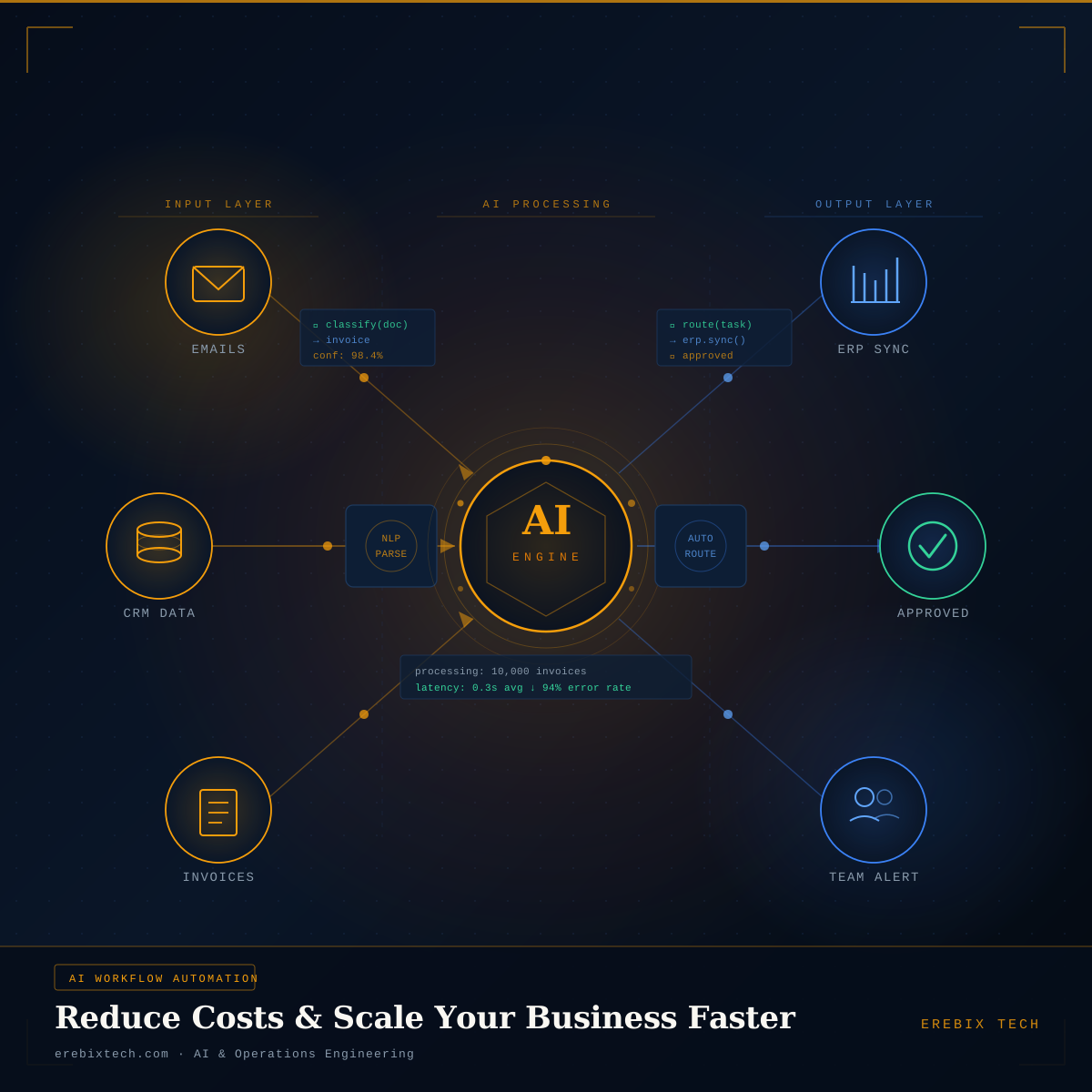
AI Workflow Automation: Reduce Operational Costs and Scale Your Business Faster
Most organizations don't fail because they lack software. They fail because information moves too slowly between people, systems, and decisions.
Picture a high-value sales lead landing in your inbox. A team member manually copies it into the CRM. Another reviews it before routing it to sales. Once closed, the customer's details get re-entered into project management tools, billing systems, and internal databases—by hand.
Every one of those handoffs is a tax on time, accuracy, and your team's focus. Gartner estimates that the average organization loses $12.9 million per year to poor data quality—and over 25% of organizations report losing more than $5 million annually from manual data entry errors alone. Multiply that by hundreds of leads, invoices, and support tickets a month. That's not a software problem. That's an architecture problem.
"As transaction volumes grow, micro-inefficiencies compounding across teams don't just slow you down—they become hard structural limits on your growth ceiling."
AI workflow automation is the architectural fix. By eliminating the manual friction between your systems and your people, it lets your organization do more without proportionally hiring more.
Beyond Legacy RPA: The Paradigm Shift to Cognitive Automation
To understand where traditional automation fails, you need to grasp the difference between rule-based RPA and AI-driven cognitive automation.
Legacy Robotic Process Automation is deterministic by design. It follows rigid "if-this-then-that" logic and breaks the moment a user interface shifts by a pixel or an invoice arrives in a slightly different layout. It requires perfectly structured data to function—and real business data is rarely perfectly structured.
Modern AI workflow automation is probabilistic and context-aware. Powered by Large Language Models, NLP, and machine learning, it can ingest and act on the 80% of business data that is inherently unstructured—raw emails, legal contracts, scanned receipts, customer support audio. According to McKinsey's 2025 State of AI report, 78% of organizations now use AI in at least one business function, and among those who deployed it in operations, 74% reported positive ROI within the first year.
| Dimension | Legacy RPA | AI-Driven Automation |
|---|---|---|
| Data Input | Strictly structured (CSV, forms) | Unstructured (Emails, PDFs, Audio) |
| Adaptability | Breaks on minor UI/format changes | Dynamically interprets context & intent |
| Decision Making | Binary rules only | Classification, sentiment, scoring |
| Integration | Fragile screen-scraping | Native API orchestration |
The Three Hidden Taxes Killing Your Operational Efficiency
Most leaders measure operational drag by surface metrics like hours worked per task. The real damage happens beneath the surface, in three systemic failure patterns that quietly drain capital.
1: The "Human-as-an-API" Tax
When software systems can't natively communicate, businesses default to using skilled employees as the integration layer—manually copying entries from procurement into ERP, converting email attachments into database rows. McKinsey research quantifies this directly: knowledge workers spend approximately 19% of their total working hours simply finding, validating, and consolidating information across systems. That's nearly one full day per week, per employee, consumed by the act of being a human data pipe.
2: Cognitive Context-Switching Fatigue
Every time an employee stops a strategic task to categorize an invoice or route a support ticket, they pay a steep cognitive tax. Research consistently shows it takes over 20 minutes to regain deep focus after even a minor interruption. In a finance team of 40 professionals, Gartner estimates this translates to 25,000 hours of avoidable rework per year—the equivalent of 12 full-time employees' annual output—consumed entirely by error correction and manual reconciliation.
3: The Cascading Latency Trap
In manual workflows, one delayed handoff cascades downstream. A contract waiting in a manager's inbox stalls the procurement team, which delays operations, which postpones client onboarding. Cascading latency doesn't just slow delivery—it damages retention, chokes cash flow, and compounds month over month. In supply chain contexts specifically, a single documentation error—one mistyped digit on a Bill of Lading—can trigger customs holds and compliance fines ranging from $1,000 to $5,000 per incident, transforming a clerical typo into a direct margin drain.
Key Insight: These aren't isolated inefficiencies. They are architectural failures that grow proportionally with your transaction volume. The only durable fix is structural—not tactical.
The Real ROI Math of Automation
Reducing operational overhead isn't about cutting headcount. The true financial leverage emerges when you change the fundamental relationship between revenue growth and operating expense.
In a manual model, scaling your transaction volume 10× requires scaling your administrative headcount by a similar factor. This linear growth model caps profitability at a ceiling defined by your hiring budget.
AI workflows decouple transaction volume from human labor. McKinsey data shows organizations deploying AI automation see an average 35% reduction in operational costs within the first year. In financial services specifically, AI-powered reconciliation reduces manual processing time by 30–50%, while cutting error rates from the industry average of 15–20% in manual processes down to near-zero. An automated pipeline processes 10,000 invoices as seamlessly as 10—without adding a single back-office hire.
Beyond headcount, consider error remediation costs. A single data entry mistake in a financial log or shipping manifest doesn't just create one error—at scale, Gartner's research shows 18–40% of records in manual systems contain at least one error that compounds downstream. Automated workflows verify inputs against live database registries in real time, systematically eliminating these error-correction loops before they cascade into audit failures, customer disputes, or compliance exposure.
Deep-Dive: High-Impact Industry Use Cases
Supply Chain & Logistics — Dynamic Exception Handling
The problem: Inbound Bills of Lading and customs documents arrive from hundreds of global vendors in completely unstandardized formats, overwhelming logistics coordinators and stalling clearance. A single mistyped field—an incorrect HS code, a mismatched consignee address—can trigger a customs hold carrying compliance fines of $1,000–$5,000 per incident. At volume, these aren't edge cases. They are a structural cost embedded in every manually processed shipment.
The AI solution: Deep-learning document pipelines automatically extract over 24 critical data points per document, match them against internal Purchase Orders in real time, flag customs discrepancies before submission, and route exceptions to analysts—while auto-approving compliant shipments instantly. The result is not just speed. It's the elimination of an entire error class from your cost structure.
FinTech & Financial Services — Multi-Entity Reconciliation
The problem: Accounting teams lose days manually reconciling disparate bank ledgers, payment gateway payouts, and internal ERP entries. In a 40-person finance department, Gartner estimates this manual overhead consumes 25,000 hours annually—approximately $878,000 in fully-loaded labor cost—on work that produces zero strategic output. Meanwhile, manual error rates of 15–20% mean that a significant portion of those reconciled entries will require re-examination during audit.
The AI solution: Intelligent reconciliation engines match transactional records using probabilistic token matching, accounting automatically for currency fluctuations, regional fees, and timing delays. McKinsey benchmarks show AI-driven reconciliation reduces processing time by 30–50% and cuts error rates to near-zero—converting a resource-intensive back-office function into a fully auditable, near-real-time operation.
B2B Professional Services — Intelligent RFQ Processing
The problem: Engineering and consulting firms miss revenue because analyzing hundreds of pages of complex RFPs to build labor estimates is slow, inconsistent, and analyst-dependent. A firm processing 50 RFPs per quarter with 3-day manual turnarounds is structurally capped in its bid capacity—and losing to faster competitors who respond first.
The AI solution: Semantic search workflows ingest the RFP, map compliance requirements against the firm's skills and capacity inventory, draft a preliminary bill of materials, and deliver an optimized resource allocation model to the executive team in minutes—not days. The competitive implication: your firm can evaluate and respond to 5× the bid volume without expanding your pre-sales headcount.
Before You Automate: 4 Infrastructure Prerequisites
Automation applied to broken or poorly structured processes doesn't improve them—it accelerates the chaos. Before selecting any vendor or writing a single script, organizations must evaluate four structural dependencies:
-
Process Density & Stability — Target workflows that are highly repetitive and carry significant transaction volume. Standardize the business logic first. Automating a shifting process only locks in the instability at machine speed.
-
Semantic Data Pipeline Integrity — AI models are only as good as their inputs. Siloed, duplicated, or poorly formatted internal data registries will degrade every downstream automated decision. Gartner estimates that poor data quality costs organizations an average of $12.9M per year—automation built on bad data amplifies that loss, not reduces it.
-
Integration Topology — Map your system dependencies before building. Your automation layer must interact with CRMs, legacy databases, and cloud storage via robust API frameworks—not brittle screen-scraping that collapses on the next software update.
-
Algorithmic Governance & Audit Trails — In regulated industries, transparency is non-negotiable. Automated workflows must leave immutable audit logs, enforce role-based access controls, and flag edge-case anomalies for human-in-the-loop review.
The Erebix Tech Approach: Engineering Intelligent Workflows
Navigating those four prerequisites is precisely where most automation initiatives stall. Mapping process density, validating data pipeline integrity, auditing integration topology, and designing governance frameworks—each one is a specialized discipline. Attempting to self-diagnose across all four while simultaneously running core operations is how well-intentioned automation projects turn into expensive technical debt.
This is the exact structural discovery work that Erebix Tech handles for you.
At Erebix Tech, we approach automation from an engineering and process-first perspective. Every engagement begins with a comprehensive process discovery phase—mapping your operational architecture in detail to pinpoint hidden bottlenecks, isolate redundant manual tasks, and identify structural integration gaps before any solution is proposed or any line of code is written.
We don't offer generic plug-and-play toolkits. We architect tailored, secure AI workflow solutions built around your actual operational realities—ensuring the systems we build stay efficient as your business evolves, not just on deployment day.
Conclusion
AI workflow automation is no longer a luxury reserved for enterprises with nine-figure IT budgets. McKinsey data confirms that businesses deploying AI automation save an average of 35% on operational costs within the first year—and organizations with high AI maturity report sustaining those gains for three years and beyond.
The most successful initiatives focus on optimizing architecture, not chasing trending tools. Moving information faster, maintaining data integrity, and making decisions from real-time insights—these are the defining traits of companies that compound their competitive advantage year over year.
The question isn't whether your organization should automate. The question is: which operational bottleneck will you solve first?
Ready to transform your operational efficiency? Contact the team at Erebix Tech today to schedule your workflow automation assessment.
Frequently Asked Questions
What exactly is AI workflow automation?
It is the systematic replacement of human decision routing with machine intelligence across your operational architecture. Rather than relying on deterministic IF/THEN rules that collapse on format variation, AI workflow automation deploys LLMs and NLP to interpret unstructured inputs—emails, contracts, scanned invoices, audio logs—and execute context-aware routing, classification, and action across departments. The operational consequence: your workflows become more accurate and faster as transaction volume increases, rather than degrading under load as manual systems do.
How is AI automation different from traditional RPA?
Traditional RPA is a deterministic rule engine. It fails the moment an input format deviates from its programmed expectations—a single UI change or invoice layout variation can break an entire workflow. AI-driven automation operates probabilistically: it interprets intent, handles structural variation, and makes weighted decisions based on context. Where RPA demands perfectly structured data to function, AI automation is built precisely for the messy, variable, real-world data that constitutes the majority of your operational inputs. McKinsey estimates that 80% of enterprise business data is unstructured—the exact territory where legacy RPA cannot operate.
What business processes are highest-priority automation targets?
The highest-ROI targets share three characteristics: high transaction volume, rule-heavy decision logic, and current dependence on manual data transfer. In practice, that translates to invoice processing and three-way PO matching, multi-entity financial reconciliation, CRM data entry and lead routing, contract analysis and obligation extraction, RFP parsing and resource allocation modeling, and compliance reporting workflows. Gartner identifies intelligent document processing as one of the fastest-growing enterprise automation segments precisely because it addresses these high-volume, error-prone inputs at the architectural level.
How much does AI workflow automation cost—and what is the realistic ROI?
The investment spectrum is wide: off-the-shelf automation tooling starts at a few hundred dollars per month; custom enterprise-grade architectures involving deep system integration, compliance frameworks, and governance design are project-based engagements. The more operationally useful metric is payback structure. McKinsey's 2025 benchmarks show organizations achieve an average 35% operational cost reduction in year one. For a finance team of 40, Gartner quantifies the elimination of avoidable rework at approximately $878,000 annually. Most organizations with well-scoped implementations cross their payback threshold within 6–18 months.
Will AI automation reduce my headcount?
No. It changes your operational leverage ratio. In a manual scaling model, a 10× increase in transaction volume requires a near-proportional increase in administrative headcount—a linear relationship that caps your operating margin. AI automation decouples transaction volume from headcount. Your existing team's output scales 3–5× without expanding your overhead structure. The strategic reallocation is from low-judgment data transfer work toward the analytical, relational, and strategic functions that actually drive revenue. Headcount reduction is rarely the mechanism; headcount redeployment is.
What is the realistic implementation timeline?
A single-process automation scoped against a stable, well-documented workflow can reach production in 2–4 weeks. Complex multi-system enterprise architectures—spanning CRM, ERP, compliance layers, and document ingestion pipelines—typically require 2–4 months from discovery through deployment. The decisive variable is process documentation quality. Gartner's research on AI implementation failure finds that 57% of failed initiatives collapsed because organizations attempted to automate poorly defined or unstable workflows. Standardizing business logic before writing any code is not a preliminary step—it is the foundational investment that determines whether the automation compounds value or compounds chaos.
How is sensitive data protected in an automated workflow?
Enterprise-grade AI automation enforces security through layered controls: role-based access tokens at the API level, end-to-end encryption in transit and at rest, immutable audit logs for every automated action, and anomaly flagging for edge-case transactions that require human-in-the-loop review. For organizations operating under GDPR, SOC 2, HIPAA, or financial services compliance frameworks, automation architectures can be designed to enforce regulatory requirements structurally—making compliance a property of the system rather than a manual audit exercise. IBM's 2024 global security study puts the average cost of a data breach at $4.88 million; governance-first automation design is a meaningful upstream mitigation.
Where does an organization begin—and how does Erebix Tech fit into that?
The correct starting point is a structured process audit: map every workflow your team executes repeatedly, quantify the hours spent, and identify where manual errors most frequently surface. Rank by transaction volume × error rate × strategic impact. The highest-scoring workflow is your automation entry point. But identifying that workflow is only the diagnostic layer. The harder work—validating data pipeline integrity, mapping integration topology, designing governance frameworks, and scoping the technical architecture—is where most internal initiatives stall. Erebix Tech's process discovery engagement handles this exact structural analysis, giving you a clear, risk-assessed automation roadmap before any engineering resources are committed.
Published by Erebix Tech Research Division